When isn’t an asset purchase an asset purchase?  When the purchase of the assets are intended to run the business as a going concern.  So said the Eighth Circuit Court of Appeals on July 5, 2016, in Day v. Celadon Trucking Services, Inc.  So, what’s the big deal?  Well, on a 10,000 foot level, in a typical asset purchase (versus stock purchase), employees may or may not be hired by the new entity. In this case, the buyer, Celadon Trucking Services, Inc., decided to hire 201 of the 658 employees of the seller, Continental Express, Inc.  The rest remained employed by the seller to terminate. Unfortunately, the seller did not provide the remaining employees with the required 60 day Worker Adjustment and Retraining Notification (“WARN”) Act notice for a mass layoff. Thus, the terminated employees sued the buyer (deep pockets since the seller was broke), seeking damages under the WARN Act.

Here is where things take a detour, and to those of us on the employer side, defies logic at first blush.   Continue Reading 8th Circuit Holds That A Buyer In An Asset Purchase May Be Liable Under the WARN Act For the Seller’s Failure to Provide Advance Notice of Mass Layoff

Dollars 2As I wrote about in April, on February 1, 2016, the EEOC proposed revisions to add wage and hour information to employers’ yearly EEO-1 report.  The EEO-1 report is required by the EEOC, pursuant to its authority in Title VII of the Civil Rights Act of 1964 (Title VII), and requests submission of information aimed at detecting discriminatory practices.

The proposed revision is the recommendation of a 2010 Equal Pay Task Force between the EEOC, DOL and President Obama’s National Equal Pay Task Force. The EEO-1 survey is used by the EEOC and the OFCCP (Office of Federal Contract Compliance Programs) to analyze and enforce non-discriminatory employment (such as a contractor who hires no minorities). According to the EEOC, this information will enable it to compute and compare pay between men/women and various races and ethnicity to find potential discriminatory pay practices.

Following the closing of the April 1 comment period, the EEOC has since revised its proposal, as summarized below.  The comment period for the new revisions closes August 15, 2016.

Who Needs To Complete An EEO-1 Report?

The EE0-1 survey must be filled out by all employers subject to Title VII with 100 or more employees (this includes corporate enterprises and/or shared ownership) and federal contractors / first-tier subcontractors subject to Executive Order 11246 (government contract over $10,000) with 50 or more employees and a prime contract or first-tier subcontract of $50,000 or more. Employers with 50-99 employees would not need to report this new additional pay and hours worked data (now called “Component 2” of the EEO-1) , just the current information such as race, gender, etc. (“Component 1”).

The proposal would change effective the 2017 reporting cycle for employers with 100 or more employees – they would need to add the pay and related information by March 31, 2018. Note- this is a 6 month extension from September 2017 (which was originally proposed). Thereafter, the EEO-1 report will be due by March 31st of each subsequent year.  Keep in mind, however, the September 30, 2016 deadline and EEO-1 reporting is unchanged!  According, employers would report September 30, 2016 with the old form, and the next report would be due March 31, 2018, with the new data/form.  A sample of the proposed new EEO-1 report can be found here.

What New Data Must Be Reported?

The proposal would require covered employers to provide data on employees’ W-2 earnings and hours worked based on a calendar year basis ending December 31.  This is a significant (positive) change over the EEOC’s first proposal. Employers would use the W-2 Box 1 income figure used for end-of-year tax reporting.  Thereafter, employers will need to aggregate W-2 data in 12 “pay bands” (pay range, for the rest of us) for 10 different job categories: Executive/Senior Level Officials and Managers; First/Mid-Level Officials and Managers; Professionals; Technicians; Sales Workers; Administrative Support Workers; Craft Workers; Operatives; Laborers and Helpers; and Service Workers).

As for how to report the “hours worked” component for full-time salaried employees, the EEOC now is recommending that for non-exempt employees, actual hours be reported.  For exempt (salaried) employees, an employer would have the option of: (1) reporting actual hours worked; or (2) report 40 hours per week for full-time employees and 20 hours per week for part-time employees multiplied by the number of weeks the individual is employed during the EEO-1 reporting year.

In short, we hurry up and wait again…

According to the City of Minneapolis’ Charter Commission Agenda, the Charter Commission is set to review the petition from the 15Now Minnesota Committee for a proposed Charter amendment related to the proposal to increase the minimum wages within the City of Minneapolis to $15 per hour. The regular meeting will be held on July 13, 2016 at 4:00 p.m. at City Hall, Room 317.

While this $15 push for minimum wage is nothing new (it was initially proposed by Minneapolis City Council Member Alondra Cano around August 2014 according to the StarTribune), certainly given the latest City pro-employee trends (i.e. Minneapolis Sick and Safe Leave Ordinance), it may have a bit more traction than ever before.  Accordingly, I suspect this is something we may be hearing much more about this Summer…

In the wake of all the hoop-la about the overtime changes, I wanted to post a reminder to our Minnesota employers to prepare now (in your payroll system, personnel records, etc.), for the minimum wage increase effective August 1, 2016, lest you find yourself at the receiving end of a MnDOLI audit or complaint.  In case you’ve gotten too much sun this summer and have forgotten – here are the increased minimum wages:

Minimum Wage Effective August 1, 2016
Large employer wage $9.50/hour
Small employer wage $7.75/hour
90-day training wage
(under 20 years of age)
$7.75/hour
Youth wage
(under 18 years of age)
$7.75/hour
Inflation increase Inflation indexing begins Jan. 1, 2018

Small employers are those with annual gross revenue of less than $500,000. Large employers are, not surprisingly, those with an annual gross revenue of $500,000 or more.

Keep in mind that Minnesota minimum wage is higher than federal minimum wage, thus, these hourly wages will apply to all hours worked (part-time or full-time). Also, I’ve said it before, but Minnesota law does not allow a tip credit. Therefore, employers should not count tips as part of meeting the above minimum wage requirements. Finally, there are some limited exemptions from Minnesota’s minimum wage laws – babysitters, taxicab drivers, nonprofit volunteers, people providing police or fire protection, employees subject to US DOT provisions, and a few other quirky positions.

USDOL_Seal_circa_blue_2015On June 30, 2016, the U.S. Department of Labor issued two interim final rules to adjust penalties for inflation (one relating to H-2B workers and the other regarding all others). The DOL will accept comments on these rules for 45 days before it finalizes the rules.

Important to my wage and hour followers, the Wage & Hour Division’s penalty for willful violations of the minimum wage and overtime provisions of the Fair Labor Standards Act will increase from $1,100 to $1,894. In addition, OSHA’s maximum penalties will increase by 78% – the top penalty for serious OSHA violations will rise from $7,000 to $12,471, and the maximum penalty for willful or repeated OSHA violations will increase from $70,000 to $124,709.

These penalties will apply to civil penalties assessed by the DOL after August 1, 2016, for violations occurring after November 2, 2015.  A chart of all the penalty adjustments made under the Inflation Adjustment Act can be found here. Further, keep in mind that, pursuant to the Act, these penalties will, moving forward, be adjusted each year for inflation.

In its June 21, 2016, Compliance Tips, the City of Minneapolis Department of Civil Rights Contract Compliance Division offered some tips for how a contractor can demonstrate good faith efforts at meeting the City’s workforce goals.  Given the recent notice of on-site “reviews” that I blogged about earlier, this is no surprise. Contractors should expect the City will also be auditing compliance with the workforce goals, and should be prepared to make this showing. Here’s what advice the City has to offer:

“The City’s workforce goals are 6% female and 32% minority workers on all city construction projects. A contractor must demonstrate a good faith effort to meet these goals. A good faith effort means that a contractor took reasonable steps to employ female and minority workers and cure existing underutilizations in its workforce through Affirmative Action and Equal Employment Opportunity.

A contractor can demonstrate its workforce good faith efforts in the following ways:

  • Provide documentation that it has alerted its subcontractors, unions, and trade organizations of the City’s workforce goals.
  • Use its current Affirmative Action Plan, or create a new one, to develop a female and minority worker recruitment plan
  • Advertise opportunities for employment in minority and women trade publications and at job and recruitment fairs
  • Be diligent in documenting and communicating any and all efforts to CCD so that we are aware of its efforts and can help it meet its goals and are aware of its efforts.

Contractors must be truthful when submitting utilization percentages to CCD.”

Contractors doing business in Minneapolis should be aware that the City will be conducting on-site “reviews” of the general contractor for City projects. Don’t get fooled that this is a friendly visit just because you are called in advance to schedule a time to meet. This “review” is an audit or investigation or whatever you want to call it. It is the City’s way to determine whether you are in compliance with your contract. A violation is a violation. Be sure you have the proper postings, records, and are paying the appropriate prevailing wages. Keep in mind that just because the City’s contractor compliance officers are knocking politely, doesn’t mean they don’t communicate with MnOSHA and other agencies.  Be sure your job site is in compliance with not only City regulations and ordinances, but state and federal as well. Here is the notice that I received from the City on June 21, 2016:

“Contract Compliance Officers (CCOs) will be conducting onsite reviews on construction projects. Developers and Contractors can expect that a CCO will schedule the onsite with the general contractor in advance. During the review, the CCO will tour the job trailer and job site looking for relevant postings (i.e. wage decision and City’s Non-Discrimination Notice).  Then the CCO will interview employees and subcontractors. Specifically, the CCO will be reviewing whether:

  • Women and minority businesses are providing a commercially useful function.
  • Female and minority workers are being utilized and are not experiencing any discriminatory treatment.
  • Employees are being paid prevailing wage
  • Apprentices working on site are utilized within ratio and paid according to their pay scale.

The review will vary in length depending on the size of the project and number of employees interviewed. Afterward, the CCO will produce and share an onsite report with the project contacts.  Then the CCO will work with the general contractor and/or developer to remedy any noncompliance issues. Any questions regarding upcoming onsites can be directed to the CCO assigned to the project or via email at contractcompliance@minneapolismn.gov.”

Note, even the City has acknowledged that you may be found in noncompliance as a result of the “review” – and if that is the case, you will need to “remedy” the “issue”.  This is simply a workplace investigation without a complaint, in order to determine whether you are in compliance with the terms of the contract with the City.  Contractors are highly encouraged to review your practices now and get into compliance if you are not already!

Construction progress of the U.S. Bank Stadium (new Minnesota Vikings stadium), as seen from the Haaf Ramp in Downtown East, Minneapolis, Minnesota, on 3 December 2015.

The Minneapolis City Council significantly amended its Prevailing Wage Ordinance today.  The revised ordinance will go into effect following publication (generally 8 days after the approval of the revisions).  Accordingly, the revisions will likely be finalized before July 1, 2016. The revisions provide individuals with a private right of action for violations (they can sue their employer); add certification requirements; requires certified payrolls be provided to the City, and add penalties, among other things. Following are the key changes:

  • Clarification of the City’s current practice to enforce contracts of at least $50,000.  Any contracts less than $50,000 will be reviewed on a complaint-made basis only, unless subject to the DBA.
  • Mandating that all contracts requiring prevailing wages to be paid must contain a provision stating that the contractor must comply with the City of Minneapolis Prevailing Wage Ordinance. This onus is on the City – though certainly if they forget to put it in a contract, the contractors will still have to comply with the ordinance as they will argue it was clear in pre-bid meetings…yes, I’ve heard that before.
  • Determining that any laborer, mechanic, or employee employed by a contractor (or sub) is intended to be a third-party beneficiary of the contract.  This is actually a very big deal – currently, contractors are able to argue that third-parties (such as employees) are not beneficiaries of a contract between the city and a contractor, and thus, the lawsuit is improper. Accordingly, when a contractor allegedly breaches the contract by failing to pay prevailing wages, the employee has no private right of action to sue the employer because the employee was not a party to the supposedly breached contract.  This change will allow anyone to sue the contractor for breaching the agreement with the City.  This will bring the ordinance in line with the Minnesota Prevailing Wage Act. The Federal Davis-Bacon Act does not allow a private right of action.
  • Adding certification requirements after bid opening and prior to the contract award.  The contractor will have to submit to the Minneapolis Director of Civil Rights, a wage compliance certificate guarantying payment of prevailing wages and confirming identity of subs and suppliers and their benefits agents, job classifications that will be used (including each sub), anticipated number of hours to be worked for each class of labor, the prevailing wages and benefits for each class, and proof that all subs are independent contractors.
  • Requiring that all laborers and mechanics working on the project are paid at least every two weeks (bi-weekly).  Minnesota law mandates that wages must be paid at least monthly, so this will reduce that by half.  However, rarely are contractors paying monthly, so this is likely to be a non-issue.
  • Requiring that the contractor provide the Director a bi-weekly certified payroll. Failure to do so may result in withholding of payments and audit of books and records. Certified payrolls must be retained for 1 year after completion of the work.
  • Confirming the Department will monitor compliance, including review of certified payrolls and job site visits.  The Department must participate in the pre-award conference and the review of the certified payroll reports.
  • Adding penalties for failing to comply with the ordinance. Such penalties may include withholding payment for that project or other projects with the City, a 5% penalty on contract price as liquidated damages, and suspension or debarment. The rules for this exact process will have to be created (i.e. due process).
  • Adding a section requiring subcontractors and independent contractors to provide the Department of Civil Rights with certain proof regarding their status.  Specifically, that they are a “bona fide” independent contractor including business filing with the Secretary of State (be sure it is right too – I’ve seen them confused over a “Co.” and “Inc.” error!).  Also need to provide proof of workers’ compensation and unemployment insurance.

So, what’s next? Expect these changes to roll out in pre-bid documents starting in July. Contractors bidding prevailing wage jobs in Minneapolis should be familiar with the revised ordinance, and be prepare to follow the new requirements, lest you find yourself in a sticky situation with the Department.

As school is out for the summer and teens are hitting the workforce, employers may be asked to turn over the minor’s wages to his or her parent. Is this legal? Yes, according to the Minnesota Payment of Wages Act:

Any parent or guardian claiming the wages of a minor in service shall so notify the employer and, if failing to do so, payment to the minor of wages so earned shall be valid.”

Minn. Stat. 181.01. A minor has control of his or her earned wages unless such a request is made. However, I suspect this is much more common with child actors than your fast food worker teen. This is such a quirky law that I recently was made aware of, I couldn’t not share it – so there you go! If you want to learn more about paying minors, I blogged about it here. If you want to learn more about the hours minors can work, I blogged about it recently as well here.

Kenney Equal Pay ActThe EEOC issued new resource documents today in connection with its White House United State of Women Summit. The EEOC issued the following:

As with its earlier ADA guidance, the above “resource documents” are simply new webpages providing guidance for the above topics. For example, the EEOC’s proposal to collect pay data is not new, I blogged about it earlier. However, the new guidance notes that, following the first public comment period regarding the proposal, it will submit additional revisions and revised proposal for a second comment period this summer, 2016.

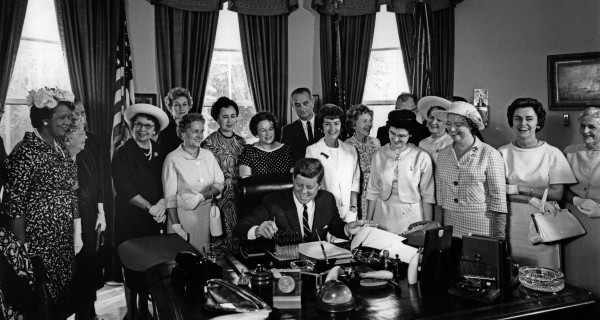
In short, the guidance reinforces that men and women must be paid equal wages if they perform the substantially same work, in the same workplace, under the Equal Pay Act (the picture above is President John F. Kennedy signing the Act into law in 1963).   “Wages” includes pay, overtime pay, bonuses, stock options, profit sharing, bonus plans, life insurance, vacation and holiday pay, and other forms of compensation.

What About Minnesota’s Equal Pay for Equal Work Law?!

Minnesota also has its own Equal Pay for Equal Work Law, Minn. Stat. 181.66 – .71.  Minnesota requires that employers (1 or more employees) similarly cannot discriminate against employee’s wages based on sex. The exception is public employers and employers that make payments based on a seniority system, merit system, piece rate system, or other differential based on any other factor other than sex.  Naturally, employers may not retaliate against an employee for making a complaint under this law.

What are the penalties for violating Minnesota’s Equal Pay for Equal Work Law? You don’t want to find out. An employee can sue the employer in court for the amount of unpaid wages for the previous year, plus an equal amount as liquidated damages, plus attorneys’ fees. Such an action may be brought by one employee or more collectively. This will add up much quicker than you would think. To put it into perspective, in Ewald v. Royal Norwegian Embassy, a single plaintiff was awarded $170,594 in lost wages and $100,000 in emotional distress.  The court then awarded the plaintiff’s attorneys $1.98 million – yes, that’s $1,983,692.66 ($1.7M in attorney’s fees and $209,973.61 in costs), as well as prejudgment interest on Plaintiff’s damages in the amount of $114,267.31. Thus, employers would be wise to internally audit their pay practices, at least annually, to ensure that pay ranges are consistent across the board within a certain position so you don’t find yourself in Norway’s boots.