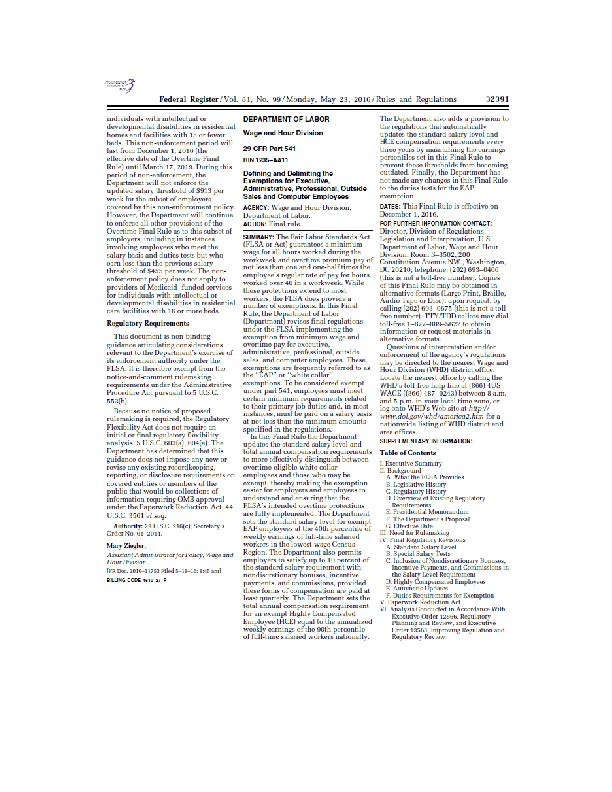
Final OT Rule PicThe final overtime rule amending the DOL’s regulations under the FLSA was published today in the Federal Register, which you can find here.  This isn’t new news, far from it, it is just the “official” residing place for the amendment and a very long 158 page story of how it came to be, the process, and the justification for it.  Some of you, like me, may find this interesting or useful. Others, not so much. Anyway, to save you some time, below is what you can find in the final rule’s 162 pages (note: the actual amendments are on pages 159-162). As you can see, a whopping 3 pages contain the larger-than-life amendments that are currently rocking the business world.

Table of Contents

Continue Reading Overtime Rule Published in Federal Register – No New News

imageAs employers are scrambling to reclassify employees from salaried to hourly (I’ll use these terms, though I know you all know that really means exempt and non-exempt from the FLSA’s overtime and minimum wage requirements), many are going to be dealing with the aftermath of angry employees.  Why?  For the most part, tracking time and the perception they are no longer professional and trusted to just get the job done and because now they have another burden.  As one who has to track every minute of billable work, I can certainly appreciate that feeling of dread in recording time worked!  In fact, many attorneys leave private practice to go in-house, with not having to record time as a main decision factor.  I get it!  So, what’s an employer to do?  Well…the Department of Labor has clarified with its new overtime rules that there are many ways to meet the employers’ record keeping burden with respect to an hourly employee’s time worked.  Fun fact: employees don’t actually have to punch a clock or record every coming and going (though I still think it’s a better practice).  Second fun fact: I took the picture of the DOL yesterday as I was visiting our Nation’s Capitol!  Talk about wage and hour geeking it out right?   Anyway, I digress. How can employer’s track hourly employee’s time?

Punch a Clock.

First, certainly, an employee may be instruced to punch a clock.  Back when I was working at my first job in the 1990’s at Iowa Book, a student bookstore at the University of Iowa, we literally punched a clock with a time card, similar to this one in the picture.Computerized_time_clock However, now with the Internet and electronic devices, there are many fingerprint scanners, key cards, and mobile device apps or telephone call-in systems for employers to utilize.  Even the DOL provides an app for tracking employees” time!  Still, each of these actions burden the employee, and so yes, there is going to be some unhappiness no matter the method.  Don’t fall prey to this unhappiness – it is the law, and something employers and employees can’t agree on (or contract out of).  Let me be clear – and employee cannot “agree” out of any rights (or employer responsibilities) under the FLSA.

Agree on a Default Schedule & Deviations Therefrom.

Second, for employees who work a normal, say 8 – 5 schedule, the employer and employee can agree to a “default schedule” that reflects the employee’s daily and weekly hours; in this instance, the employee needs to only indicate when he or she deiated from that set schedule.  In that case, the employer must record the changes to the hours worked.  A word of caution, however, this method requires great trust in the employee, that he or she will actually notify the employer when hours are worked – or not worked – outside of of the set schedule.  If, for example, the employee does not notify the employer of the changed hours, the employer is still on the hook to pay for those hours.  So, if the employee gets terminated, for example a year later, it would not be unheard of for that employee to then argue she or he had to work those hours “off the clock” or was “not allowed” to deviate, or was “forced to”.  See where I’m going with this?  Simply, this great idea of the DOL does have some exposure if not very well watched over.  Don’t forget, at the end of the day, the EMPLOYER is always responsible for recording the employee’s accurate hours worked.  This is why you’ll get a record keeping claim with any claim for lost wages.

Employee Self-Reports Daily Time By End of Pay Period.

A third way to record hours is related to employees who work a flexible schedule.  In this case, the DOL notes in its guidance that the employer must keep an “accurate record” of the daily hours worked.  Thus, The DOL states:

an employer could allow an employee to just provide the total number of hours she worked each day, including the number of overtime hours, by the end of each pay period.”

Again, while this is an acceptable method, see Fact Sheet 21: Recordkeeping Requirements under the FLSA, the same caution as in the second example above.  Any time the employee does not have to punch a clock of some sort (electronic or otherwise), the employer has some level of additional exposure.

For all of these options, employers should keep in mind that these newly reclassified employees (hourly from salaried) will also experience issues with breaks, lunchtime, travel time and the like.  Simply they may be used to longer lunches, walks during the day and other daily flexibility, while perhaps starting the day sooner or staying later.  Certainly, employers will want to have conversations and training with these newly reclassified employees, so they clearly understand the expectations and how to record the hours worked.  Further, be sure they are familiar with your hourly timekeeping policy in your employee handbook – and treat all employees the same who are in the same classification.  In other words, no special treatment; an hourly employee is an hourly employee.  Thankfully, this year, you can certainly pass the blame onto the DOL!

As promised in my post yesterday, the DOL has made its Overtime Final Rule public:

PART 541–DEFINING AND DELIMITING THE EXEMPTIONS FOR EXECUTIVE, ADMINISTRATIVE, PROFESSIONAL, COMPUTER AND OUTSIDE SALES EMPLOYEES

You can access its 508 pages by clicking here, or here is the link: https://s3.amazonaws.com/public-inspection.federalregister.gov/2016-11754.pdf

To get to the actual new rules/amendments – go to page 497.

For those that read my blog late last night – I was so excited, I did mistype 2017 instead of 2016! Sorry for any confusion, though I’m sure you all figured it out quickly.

DOL Wage Hr DivThe wait is finally over!  Tonight the Department of Labor (DOL) announced that it is releasing the final rule tomorrow, May 17, 2016, “Defining and Delimiting the Exemptions for Executive, Administrative, Professional, Outside Sales, and Computer Employees” which will mandate the new minimum salary level to be $913/wk or $47,476 per year. The DOL’s Fact Sheet was released tonight, along with a wealth of information that is available such as Q&A, Comparison Table of the proposed rule and final rule, a Small Entity Compliance Guide, a Guidance for Private Employers, and many others. Commonly referred to as the “white collar exemption”, the Fair Labor Standards Act (FLSA) provides that all employees subject to the FLSA are entitled to overtime, unless they are otherwise exempt.  The actual rule was not released (go figure), so I’ll certainly post an update tomorrow (probably when you are reading this anyway as I’m having my wage and hour geek-out tonight).  Although, according to one of the fact sheets, the Final Rule should be posted here: dol.gov/whd/overtime/final2016.

In order to exclude an employee from minimum wage and overtime requirements, three thresholds must be met: (1) the employee must be paid a predetermined and fixed salary that is not subject to reduction because of variations in the quality or quantity of work (the “salary basis test”); (2) the employee’s salary must be a minimum amount (the “salary level test”); and (3) the employee’s job duties must primarily involve executive, administrative or professional duties as defined by the FLSA (the “duties test”).  Neither the salary level test nor the salary basis test applies to outside sales (I stress outside).  The Rule does not change the duties test.

Increased Salary Level & 3 Year Automatic Updates

As I wrote about in my earlier post when the rule was in the approval phase, the current threshold for executive, administrative or professional employees is that the employee must be paid a salary of at least $455/week ($23,660/year).  The significant change is that this base threshold is now increased to $913/week ($47,476/year) effective December 1, 2016.  For Computer-related employees, they may be paid the $913/wk or at least $27.63/hr.  The threshold for “highly compensated employees” (these folks do not need to meet the duties test because it is presumed they will meet it since they are highly paid) is increased from $100,000/year to $134,004/year effective December 1, 2016. Notably, unlike before (the previous thresholds were set in 2004), the new rule provides that the salary and compensation thresholds will be automatically updated every three (3) years, the amounts of which will be posted in the Federal Register at least 150 days prior to their effective date.

Also, keep in mind that there are, as always, quirks and nuances to the new rule and this blog is just a general overview of what’s to come.  For example, employees may be paid on a “fee basis” rather than a “salary basis”.  In this way, the employee is paid an agreed sum for a single job, no matter how long it takes.  However, to determine if the fee payment meets the threshold, you consider the time worked on the job and determine if that payment is at a rate that would equal at least $913/week if the employee worked 40 hours.  Thus, a computer programmer is paid $800 to fix an app and takes 10 hours to do so, this meets the test as $800/10=$80/hr x 40 = $3,200 (much more than $913).

Don’t Forget About the Duties Test – the Employee Must Be “White Collar”

Regardless of an employee’s salary, an employee may make more than the threshold amount and still not qualify for the exemption. Continue Reading Overtime Exemption Rule Announced: $47,476 Is the New $23,600, Effective December 1, 2016

BarberI got asked a great question the other day by a colleague that made me think a bit, so I thought, what a perfect topic for a blog.  So, here’s the question that started it all: Can a Minnesota employer in the service industry pay an employee the greater of: (a) minimum wage for each hour worked; or (b) commissions earned for services rendered during an employee’s shift?  Her questioning this practice stems from the thought that the employer is affirmatively stating that, for some hours, $0 is attributed to certain time at work.  In this example, let’s use a small employer, a hair salon.  The employee is scheduled to work from 8:00 a.m. to 5:00 p.m. and has 3 clients on the books (with 8 total slots for the day).  The rest of the day, the employee relies on walk-ins to fill her schedule, does other tasks around the salon to keep busy, or just waits around waiting for someone to walk-in. Some days she may leave to run errands. The employee earns $15/hr. commissions for each hour-long appointment, but credits $0/hr. for time without an appointment.

How Can the Employee Be Paid?

Can the employer pay the employee minimum wage for 8 hours of work ($7.25 x 8 = $58)?   Yes, but I know you know that.  That’s the easy one.  Can the employer just pay the employee for the 3 clients the employee serviced if the employee stayed all 8 hours? No – I know you know that too. As 3 x $15 = $45, the minimum wage requirements have not been met and the employer would have to pay the additional $13 ($58-$45) to get the employee up to minimum wage for all hours worked.  A Minnesota employer must pay for all hours worked, including waiting time, on-call time, training time, and any other time the employee is restricted to the employer’s premises.  Minn. Rules 5200.0120.  If the employee is free to leave during nonscheduled time (but must be able to receive a call to come back for an appointment), the employee is no longer working and need not be paid – so long as there are no restrictions that the employee remain close to the premises.

Can the employer just pay the employee commissions earned for services rendered during the shift?   Continue Reading Don’t Trim Off Too Much! Handling Commissions & Minimum Wage

calendarThe EEOC means business. Earlier this week, I wrote about the EEOC’s new American’s with Disabilities Act (ADA) guidance: Employer-Provided Leave and the American’s with Disabilities Act. In that blog, I noted what stuck out to me was the following guidance statements:

  • Maximum leave policies may have to be modified as a reasonable accommodation.
  • A maximum leave policy form letter (whether mailed from a third-party provider or the employer) should be modified to let employees know that if they need additional unpaid leave as a reasonable accommodation for a disability, the employee should ask for it as soon as possible.

Perhaps not coincidentally, the EEOC just announced today a $8.6 Million resolution with Lowe’s over its alleged pattern and practice of discrimination against disabled employees by firing them, and failing to provide reasonable accommodation when their medical leave exceeded Lowe’s maximum leave policy. Most employers would believe Lowe’s policy was overly generous, providing far more leave than required by the FMLA. Notably, Lowe’s policy provided that employees could take a maximum leave of 180 days (later changed to 240 days) – far more generous than the 84 days (12 weeks) required under the FMLA.  However, forgetting about ADA interplay is where the employer gets into trouble in an FMLA situation.

The EEOC’s General Counsel David Lopez cautions employers:

This settlement sends a clear message to employers that policies that limit the amount of leave may violate the ADA when they call for the automatic firing of employees with a disability after they reach a rigid, inflexible leave limit.”

Lopez further commented that this should entice employers to “voluntary comply with the ADA”.

However, what I think is not appreciated is that, many employers – and their HR professionals – and their attorneys – may not even think about time off (greater than the 12 weeks) as an accommodation.  When thinking of a “reasonable accommodation”, one tends to think of ways to help the employee come back to work and modify their job duties or work environment.  To suggest that employers should have thought of time off as a reasonable accommodation is just, in my opinion, goofy, especially when the FMLA only mandates 12 weeks’ leave. Where does the EEOC and employers draw the line?  We know “indefinite” leave is not reasonable, but what about 241 days, 365 days or more? Time will only tell how this plays out in the courts. In the meantime, Employers should carefully consider removing any maximum time off policy and handling each situation as it comes based on the facts before you.

Civil Air Patrol Lt. Col. Wayne Schulz, left, and Capt. John Barringer walk to a C-182 Cessna before departing Astoria, Ore., during Amalgam Dart 2009, June 18, 2009. Amalgam Dart is a field test of the Department of Defense's ability to rapidly deploy an integrated air defense system in the United States. (U.S. Air Force photo by Staff Sgt. Jacob N. Bailey/Released)
Civil Air Patrol Lt. Col. Wayne Schulz, left, and Capt. John Barringer walk to a C-182 Cessna before departing Astoria, Ore., during Amalgam Dart 2009, June 18, 2009. Amalgam Dart is a field test of the Department of Defense’s ability to rapidly deploy an integrated air defense system in the United States. (U.S. Air Force photo by Staff Sgt. Jacob N. Bailey/Released)

What the heck is Civil Air Patrol?  If you’ve ever seen the red, white and blue Cessna’s flying overhead, good chances are that you’ve seen a Civil Air Patrol (CAP) volunteer member flying a mission of some sort.  The CAP is an auxiliary of the U.S. Air Force, with three missions: (1) aerospace education; (2) cadet programs; and (3) emergency services.  So…you care why?  Well, aside from the amazing volunteer work this organization provides (more on that below), Minnesota law requires that employers allow employees unpaid time off to serve as a member of the Civil Air Patrol under certain conditions:

Unless the leave would unduly disrupt the operations of the employer, an employer shall grant a leave of absence without pay to an employee for time spent rendering service as a member of the civil air patrol on the request and under the authority of the state or any of its political subdivisions.”

Minn. Stat. 181.946.  For purposes of this law, an “employer” is an entity that employs 20 or more employees at a single site.  An “employee” is an individual who works an average of at least 20 hours per week.  Key here, however, is when does CAP service trigger this statute? Service under this statute has to be “on the request and under the authority of the state or any of its political subdivisions.” Accordingly, attending regular meetings, attending training opportunities, volunteering at air shows and the like, would very likely not apply.  However, if there is a natural disaster and, for example, the Governor requests the assistance of the CAP, the time off needed to perform any related mission may apply.

History of the Civil Air Patrol

According to CAP’s History of Civil Air Patrol, it started (unofficially) in the late 1930’s, with over 150,000 volunteers to defend the country.  It was officially created one week before the Japanese attack on Pearl Harbor, whereby Americans volunteered their time and airplanes to accept and perform critical wartime missions (at that time CAP was assigned to the War Department under the Army Air Corps). Overall, CAP volunteers logged more than 500,000 flying hours, sunk two enemy submarines, and saved hundreds of crash victims during World War II.  On July 1, 1946, President Truman signed Public Law 476 incorporating CAP as a benevolent, nonprofit organization.  On May 26, 1948, Congress passed Public Law 557, permanently establishing CAP as the U.S. Air Force auxiliary.  In 2014, Congress passed a bill, awarding the Congressional Gold Medal for CAP veterans’ World War II Service. Amazing stories can be found here, including that of Minnesota’s own Thomas J. O’Connor, 88, from Farmington, who still attends meetings regularly!  O’Connor joined one of CAP’s earliest cadet squadrons (I believe he was the 36th cadet to join CAP), the Minnesota Wing’s Robbinsdale unit, in 1942.  CPF_453_w_T-Bird

In August 2015, the U.S. Air Force included CAP in its definition of the “total force“, along with the Air National Guard and Air Force Reserve Command. Consistent with its status as an auxiliary of the U.S. Air Force, the Air Force recently approved CAP members to transition from the old woodland camo BDU’s, to the Air Force’s current Airman Battle Uniform (ABU’s), effective June 15, 2016.

What Does the Civil Air Patrol Do?

CAP handles approximately ninety percent (90%) of all inland search and rescue missions – saving about 75-100 lives per year. CAP members are often fist on the scene in natural and man-made disasters, transmitting satellite digital images of damage from the sky.  In it’s emergency services mission, CAP is involved in search and rescue; disaster relief; humanitarian services; Air Force support; and Counterdrug operations. Counterdrug operations is actually quite amazing – CAP will provide its resources to the U.S. Air Force and U.S. Customs Service helping to stop the flow of drugs into the United States.  They will fly overhead looking for illegal farms and drug operations – who knew?! Quiet heroes for sure.  As for cadet programs – CAP allows youth ages 12-21 to join as “cadets”, whereby they are taught aerospace education, leadership, physical fitness and moral leadership.  Similarly, CAP’s aerospace mission goes out into the public and works with educators and the general public to share knowledge of aerospace issues.  All great stuff – check it out!

swimmer-802890The U.S. Equal Employment Opportunity Commission (EEOC) issued a new resource document today titled: Employer-Provided Leave and the Americans with Disabilities Act.  A few weeks ago, I wrote about the Department of Labor’s new guide: The Employer’s Guide to The Family and Medical Leave Act. The EEOC’s document, however, is general guidance for both employers and employees.  Why now?  Maybe the Young v. United Parcel Service, Inc. case whereby a pregnant employee restricted from lifting was denied a lifting accommodation provided to others under an ADA request? I have no idea, but, the EEOC notes in its news release, that disability charges have increased by 6% over last year.  I can’t disagree.  I have also had a disproportionate amount of claims and charges over the past year that have included disability issues like I’ve never seen before.

One troubling trend the EEOC has identified in ADA charges is the prevalence of employer policies that deny or unlawfully restrict the use of leave as a reasonable accommodation.

So, it seems that as charges have been investigated, employers’ policies are not up to par.  This is a great reminder for employers to check your employee handbook – ensure your time-off policies are compliant with the ADA.  Even if you have to change it now, at least you are clarifying your (hopefully) already compliant practice. As the EEOC has this on their radar, it would be prudent to ensure your policies and employee handbook are in the clear.  Notably, here in Minnesota, we are seeing an increase in Commissioner-based charges and audits based on job application wording and questions.  There is clearly a movement toward proactive compliance – so don’t sit by and wait for an audit or charge!

In any event, the “resource document” actually is a lot less flashy than the FMLA guidance – as far as I can tell it is just a webpage on the EEOC’s website, though it does provide several helpful links to other guidance as well. The resource explains how EEOC’s existing policies and guidance applies to various situations; consolidates existing ADA guidance; addresses frequent issues including the interactive process; and provides illustrative examples.  All good stuff.

Below are some of the EEOC’s more eye-opening guidance statements:

  • An employer must consider providing unpaid leave to an employee with a disability as a reasonable accommodation if the employee requires it (and no undue hardship would be imposed), even when:
    • the employer does not offer leave as an employee benefit;
    • the employee is not eligible for leave under the employer’s policy; or
    • the employee has exhausted leave (including under FMLA or workers’ compensation).
  • When an employee requests leave, or additional leave, for a medical condition, the employer must treat the request as one for a reasonable accommodation.
    • If the leave can’t be granted under an employer’s leave program, the FMLA (or similar state or local law), or workers’ compensation, the employer should promptly engage in the interactive process with the employee.
  • The interactive process may continue even after an initial request for leave has been granted (such as if the employee’s request did not have an end date or the employee requests additional time off).
  • An employer that has granted leave with a fixed return date may not ask the employee to provide periodic updates, but may reach out to the employee to check on the employee’s progress.  (Note: this is contrary to several court opinions, so the issuance of this guidance may have an impact there).
  • Maximum leave policies may have to be modified as a reasonable accommodation.
  • A maximum leave policy form letter (whether mailed from a third-party provider or the employer) should be modified to let employees know that if they need additional unpaid leave as a reasonable accommodation for a disability, the employee should ask for it as soon as possible.  Similarly, employers are still responsible for complying with the ADA, even if a third-party administrator handles their employee leave process and paperwork (usually for FMLA).  If an employee requests additional leave, the employer should commence interactive process…again.
  • An employer will violate the ADA if it requires an employee with a disability to have no medical restrictions – that is, to be “100%” healed or recovered.
  • An employer will violate the ADA if it claims an employee with medical restrictions poses a safety risk, but cannot show that the individual is a “direct threat” (whether the disability poses a “significant risk of substantial harm” to self or others).
  • Reassignment to a new position may be a reasonable accommodation.
  • Unlike approximate dates or date ranges, an indefinite leave will constitute an undue hardship, and so it is not a reasonable accommodation.

Although no laws or regulations have changed, the EEOC’s latest guidance does provide some insight into current initiatives, the EEOC’s interpretations, and “what not to do” examples.  Notably, I think the biggest takeaway is that the EEOC is looking at employers’ unpaid leave policies and saying, it won’t let employers hide anymore behind maximum leave policies – just because an employee has taken 12 weeks of leave, does not mean that it would not be a reasonable accommodation to provide the employee a few more weeks’ leave, if required.  Therefore, when in doubt, consider the interactive process (again, and again, and again…).

There are three demands former Minnesota-based employees can make post-termination that should send all kinds of red flags to an employer.  They are often made via email and seem like innocent enough requests. Not so!  Fun fact: terminated employees are entitled to demand three things post-termination: (1) a copy of their personnel file; (2) a statement of the reasons for their termination; and (3) all wages be paid within 24 hours.

All three of these demands are statutory rights former employees have (meaning yes, they are entitled to it by law – and within a certain period of time). Many employees don’t know this unless they have either been in litigation before, have an attorney or HR friend or relative in the background that they have been complaining to, or already have an attorney lined up to make a claim against the employer.  Thus, the red flag.  Let me break it down…

Terminated Employee’s Personnel File.

I know what you’re thinking, in the words of MC HammerU Can’t Touch This!  Not so.  Minnesota employees have the right, upon written request, to review their personnel file every six months.  Terminated employees have the right to review their personnel file once per year following termination, for as long as the personnel file is kept.  Minn. Stat. 181.961.  As to terminated employees, an employer has 7 working days to make the file available for review, 14 working days if the file is maintained outside of Minnesota.  If the terminated employee asks for an actual copy (which is almost always the case), the employer must provide a copy; even if they ask to review, it is often simpler to just send the employee a copy.  An employer need not provide a current employee with a copy of his or her personnel file (review only is acceptable).

Keep in mind, however, that a request for a copy of a personnel file is usually indicative of conflict brewing.  Don’t take this request lightly.  Ensure that you produce all the “personnel record” documents as defined by Minnesota law (Minn. Stat. 181.960) – often employers will forget to produce records not normally stored in a hard copy personnel file such as payroll records, medical records, time cards, performance evaluations, unemployment documentation, grievances, time off requests, and the like.

Honestly, the statute defining “personnel record” is horrible. It pretty much says this – everything related to an employee kept by the employer is a “personnel record” except…and then it lists all the things that are not part of such record.  For example, an employer does not need to turn over information such as: written references; investigations (unless completed); certain education records; results of employee testing (except for cumulative test score); information relating to the employer’s salary system and staff planning; written comments about other employees; privileged information; medical reports and records available to the employee from a health care services provider.

Statement of Reasons for Termination.

Terminated employees may request the “truthful reason” for his or her termination within 15 working days of termination.  Minn. Stat. 181.933.  Once the employer receives this written notice, the employer has 10 working days to inform the employee, in writing, of the reason why the employee was terminated.  This statement is not subject to any action for defamation, libel or slander.  This is the time, folks, to put “Minnesota Nice” on the back burner.  You got it – it’s Hammer Time!

An employer’s statement of reasons for termination is often “Exhibit A” in a MnDOLI or EEOC Charge, demand, or lawsuit. Thus, it should be carefully drafted. For example, if an employer states in the statement that the employee was terminated due to a downsizing, and it was really poor performance, insubordination, and poor attendance – those reasons will not stand muster in a later defense. Simply, the employer has no credibility and the Courts are likely to give any other reason for termination deference.  If the facts and evidence support the employee was terminated for poor performance, insubordination, and poor attendance – that should be clear in the statement.  This is not a one paragraph letter as I have seen!  If applicable, it should have specific examples, citations to policies, references to prior warnings and the like.

Payment of All Wages Due and Owing Within 24 Hours.

This one, I know you all know, as I just wrote about it in my post a few weeks ago. To sum, (with some exceptions) an employee is entitled to pay within 24 hours of demand following termination.  Minn. Stat. 181.13-.14.

Well, there you have it – my Friday Fun Fact.  Three simple demands can speak volumes, not as well as MC Hammer, but enough – treat them like a red flag warning and put the hammer down!

CementA few weeks ago I got to toot our horn about the J.D. Donovan case, whereby the Minnesota Supreme Court held that transportation of supplies to non-work sites is not “work under the contract” pursuant to Minn. R. 5200.1106, and thus not subject to the Minnesota Prevailing Wage Act (MnPWA), Minn. Stat. 177.41-.44.  Unfortunately, it took the Minnesota Supreme Court to determine whether the MnPWA applied to a Minnesota Department of Transportation project – overruling the Minnesota Court of Appeals.  If those learned judges were unable to determine properly whether work was covered, what about the rest of us?!  Unfortunately, the MnPWA and related rules are not as clear as they could be, leading up to cases such as J.D. Donovan v. Minnesota Department of Transportation.

Generally, the prevailing wage is the hourly rate plus fringe benefits, required by law to be paid for each trade or occupation while performing work on qualifying federal, state, or local municipality-funded construction projects.  The federal Davis-Bacon Act (DBA) and each state (often called “Little Davis-Bacon Acts”) may (and often do) define “prevailing wage” and “covered work” differently.  Thus, even if you are not a Minnesota contractor – if you are doing work in Minnesota, you should take care to understand the MnPWA and how it differs from either the DBA or your usual state prevailing wage statue.

What is the Minnesota Prevailing Wage?

Under the MnPWA, the prevailing wage is the hourly basic rate of pay plus the employer’s contribution/cost for fringe benefits (medical or hospital care, pensions on retirement or death, life insurance, disability and sickness insurance, or accident insurance, for vacation and holiday pay, for defraying the costs of apprenticeship or other similar programs, or for other bona fide fringe benefits—but only where the contractor or subcontractor is not required by other federal, state, or local law to provide any of those benefits).  Whether something is a “fringe benefit” is another big issue – one for another post.  The prevailing wage rates for a project should be listed on the determination included with the bidding documents.  What if the bidding documents are missing the rates, or you want to verify?  The current commercial wage rates can be found here. The highway/heavy prevailing wage rates may be found here. Unlike some other state prevailing wage acts, Minnesota’s prevailing wage rates do not change throughout the project (with some extremely limited exceptions such as a correction).

When Does the MnPWA Apply to a Project?

The MnPWA applies to “laborers, workers and mechanics” that erect, construct, remodel, or repair public buildings or other public works, financed in whole or part by state funds.   Continue Reading When Does the Minnesota Prevailing Wage Act Apply to a Project?