While not really wage and hour related, I figured with all the new laws taking effect in Minnesota, I’d throw in a few others that I have been giving seminars on recently. Effective July 1, 2023, Minnesota law prohibits non-compete agreements for both employees and independent contractors. This new law applies to agreements entered into on or after that date. Thus, it is not retroactive, so existing non-compete agreements should still be considered valid. I say “should” because there is an argument to be made (that will be made) before the courts that two people in the same position can’t be treated differently in this regard. Specifically, if a non-compete must only be only so broad as to protect a business’ legitimate business interests, a plaintiff’s attorney may argue that it is not necessary or legitimate as other people performing the same work are free to compete.

Of further note, the ban on non-compete agreements does not extend to non-solicitation, non-disclosure, or agreements designed to protect intellectual property or confidential information. What about non-solicitation of employees? Again, I think this is going to be litigated to the extent a non-solicitation is linked to prohibiting a former employee from hiring away a current employee to work for a competitor. A plaintiff may argue that is an end-run around the law.

Two specific types of non-compete agreements are exempt from the ban: agreements made during the sale of a business or in anticipation of the dissolution of a business. What about a shareholders’ sale of their shares? The law is silent, but there was a proposed amendment during the writing of the legislation that would have specifically added that it applies to the sale of shares as well and it was not included in the bill. Accordingly, the legislature seems to have indicated that this is intended to be related to the wholesale sale of a business and just individuals’ sale of membership interests/stock.
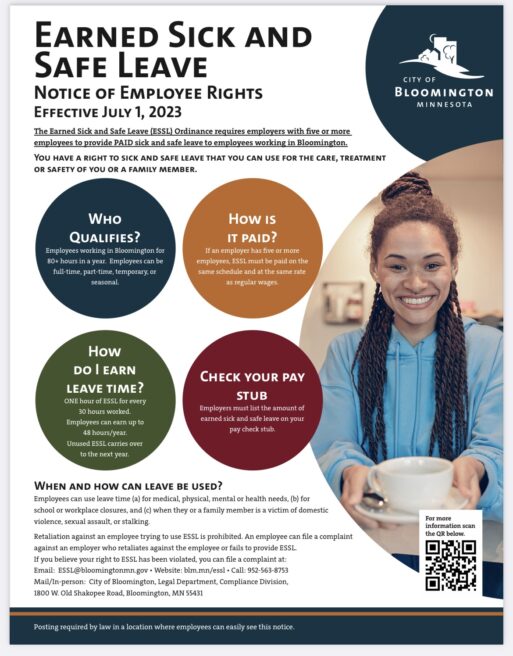
Effective July 1, 2023, all employers will need to provide earned sick and safe leave (ESSL) to ALL employees (including temporary and part-time) who work 80+ hours in Bloomington (no matter where the employer HQ is) pursuant to the new Bloomington City Ordinance. ESSL may generally be used for health needs, school and workplace closure (snow day), domestic violence, sexual assault or stalking – and all tangentially related issues stemming from them (see the ordinance for the full list). Employers with less than 5 employees must provide ESST, though it need not be paid. Employers with more than 5 employees must provide paid ESST.

This ordinance is similar to those already enacted in Minneapolis, St. Paul and Duluth. It provides for 1 hour of ESSL for every 30 hours worked, up to 48 hours per year. Keep in mind, an employer may always have a more generous policy. Additionally, if you have an existing PTO plan, you may use those hours to fulfill this ordinance requirement, so long as the accrual method is as good as or better than the ordinance, and can be used for the same reasons and in the same manner as in the ordinance. There is a 90 day waiting period before a new hire must be able to use their ESSL (you can allow them to use it sooner). Bloomington’s ordinance also allows an employee to retain ESST for a period of 120 days after their termination of employment (if rehired within 120 days, they get their time back – Minneapolis is 90 days, for example).

Although it has yet to take effect, there is already an amendment proposed that will allow accrual in smaller than 1 hour units (as it is currently drafted) and requires the time available to be on a paystub. The remedies for failure to adhere to the ordinance is also in the amendment – providing for (among other things) – reinstatement and backpay, double damages or $250 (whichever is greater); an administrative fine of up to $1,000, civil fine of $250 – $1,000 for each violation (first time offense), and more.

Employers should download and must post the notice of rights that you can find here in a conspicuous place – wherever you put other employee notices. If more than 5% of employees speak another language, the notice must also be posted in the other language (currently English is only linked, but appears they are working on Spanish, Chinese, Somali, Khmer and Vietnamese).

Finally, it is anticipated that the Minnesota State Legislature will pass a statewide paid Earned Sick and Safe Time Act (HF 19) this session, to take effect in 2024. It proposes the same 1 hour accrual for every 30 worked. Currently, it would not, however, replace any local ordinances (such as Minneapolis, St. Paul, Duluth or Bloomington) that provide for greater worker rights. In short – now is the time to do some Spring cleaning with your handbook, and if you perform work in any of the major cities, consider a PTO policy that is compliant with all of the current ordinances.

In August 2022, President Biden signed into law the Inflation Reduction Act of 2022. Under this law, there are increased tax benefits for certain clean energy projects that begin on or after January 29, 2023 – with a catch. Such projects must use both registered apprentices and prevailing wages (and fringe benefits)must be paid. Employers (construction companies, subcontractors) working on a clean energy project should be sure to verify whether this applies to you. The DOL has provided some general guidance here that such employers may find helpful.

Minnesota employers should be sure to have an updated minimum wage poster (required), reflecting the new minimum wage ($10.59 for large employers, and $8.63 for other wages). It can be downloaded for free here. Also – don’t forget Minneapolis minimum wages are more and increase every July 1. A schedule of those wage increases can be found here. St. Paul, on the other hand, also increases their minimum wages effective January 1, 2023, which is also greater. Those rates can be found here.

On October 13, 2022, the U.S. Department of Labor published a Notice of Proposed Rulemaking regarding how to determine whether an individual is an employee or independent contractor. After an extension, that comment period finally closed this week. The DOL has continued its flip-flopping on this issue. You may recall on September 22, 2020 (during the Trump administration), the DOL issued a notice of proposed rulemaking that it would adopt the economic realities test, with two core factors. I blogged about that here. In January 2021, days prior to the change of administration, the DOL issued a Final Rule, basically adopting the two “core” factor test – the nature and degree of control over the work and the individual’s ability to make or lose money based on their initiative and/or investment. Not surprisingly, a few months later, the Biden administration officially withdrew that Final Rule, which a Texas court held was unlawful, restoring it in May 2022.

Where are we today?

The latest proposed rule basically nullifies the 2021 rule, and goes back to the DOL’s position prior to the Trump administration (pre-2017) in a swift 180. The new rule states that economic dependence is the “ultimate inquiry” and whether the worker is, in economic reality, in business for themself. Don’t be fooled, however, this does not mean the amount of income earned, or if they have other income streams (according to the DOL).

The DOL’s new rule is back to looking at 6 factors as a “guide” for the “assessment of the economic realities” with no one factor dispositive – oh, and the 7th factor of a catch-all, whatever else they deem important:

  1. Opportunity for profit or loss depending on managerial skill.
  2. Investments by the worker and the employer.
  3. Degree of performance of the work relationship.
  4. Nature and degree of control.
  5. Extent to which the work performed is an integral part of the employer’s business.
  6. Skill and initiative.
  7. “Additional factors”.

To keep this short, I won’t get into the examples for all of the above, but the DOL’s examples make it very clear that the starting point is they are an employee until proven otherwise. And finally, my simple advice to clients remains unchanged – if it looks like a duck, quacks like a duck…it’s probably a duck.

On June 10, 2022, the U.S. Department of Labor (DOL) Wage and Hour Division (WHD) submitted a notice of proposed changes to its wage information collection form, WD-10, that it uses to determine prevailing wages. The WHD is also proposing a new optional form, WD-10A, which it will use before sending out the actual survey, in order to identify potential respondents who worked in the construction industry.

In other words, the new form will allow contractors to voluntarily report subcontractors with whom they’ve worked, so that the WHD can also send subcontractors the survey. This should ideally reach more non-union contractors, and thus, the rates should more closely reflect actual prevailing wages (versus union wages). Contractors have until August 10, 2022 to submit comments on the proposed notice. A summary of the changes can be found here. As always, the more non-union contractors that actually fill out and complete the survey, the better the chance that the set prevailing wage will reflect actual market (prevailing) rates.

If you are a home health care provider (personal care attendants, community first service and support workers), the Minnesota Department of Labor & Industry (MNDOLI) has created a new webpage for information related to employment practices in your industry. This includes a general video on:

  • Overtime (follow federal (40+ hrs/wk) and state law (48+ hrs/wk) at 1.5 times the regular rate) *Note – this is where I see the majority of violations – (and investigations) – make sure you are properly paying overtime – if you are paying a “bonus” for additional hours worked, I’d highly encourage you to have that pay practice reviewed asap.
  • Minimum wage requirements
  • Travel time
  • Rest periods (less than 20 minutes paid)
  • Payment of all hours worked (regardless of reimbursements)
  • Discipline for working unauthorized overtime (but paying it)
  • On-site work/rest time (sleep time – Minn. 177.23, sub.11 and Minn. Rule 5200.0121 and federal law)
  • Regular payments, timely payments and final pay law

Employers should be careful to remember that this guidance is ONLY for Minnesota state law. If federal law applies to your business and is more beneficial for the employee, then federal law applies.

Minnesota employees who are eligible for Frontline Worker Pay will be able to apply at https://frontlinepay.mn.gov starting tomorrow, June 8, 2022. That means that Minnesota employers who are in the frontline industry sector (see my previous post), must provide notice by June 23, 2022.  

MNDOLI has drafted the employer notice in several languages, which you can download here. The notice must be given to each employee and/or placed where all other notices (such as your minimum wage poster) are posted. For many employers this is a breakroom, kitchen or job trailer. If you chose to provide notice to each employee, I would also recommend posting it as well, to be sure nobody is missed and/or loses the notice.

A detailed list of the industry sectors (and now with examples) can be found here.


The Minnesota Department of Labor & Industry is indicating that the frontline worker pay application period will be open from June 8 to July 22, 2022.  Within 15 days – June 23, 2022, employers in the applicable sectors (see my previous post) will need to post the notice.  The notice will be available at frontlinepay.mn.gov when the application dates are finalized.  There are also a few webinars today at 1 pm and Friday, June 3 at 3:30, and an outreach toolkit (this is NOT the employer notice). That’s all I know, folks!

As promised, I’m sharing what I know.  As of now, the Minnesota Department of Labor & Industry (MNDOLI) is indicating that their goal is to launch the frontline worker pay application mid-June (at which time the 45 day application period will begin).  MNDOLI anticipates payments will be made late summer or early fall.