fitness

I cannot say this enough. Even if payroll deductions are authorized and/or allowed (for example, an employee agrees or a court order for child support), an employer cannot take so many deductions that an employee’s regular rate dips below minimum wage. Period. End of story. There are no exceptions to this that I am aware of (okay, well, at least for employees who are subject to minimum wage laws – there are a few specific exceptions not worth mentioning here – if you are in the industry, you know it). I wrote about this in an earlier post related to deductions for losses, theft or damage. An employee cannot agree to deductions that will take their regular rate below minim wage – even if they want you to take excessive deductions, you cannot do it.

Case in point – the DOL has recently announced that Life Time Fitness has agreed to pay 15,909 employees for back wages and liquidated damages in an amount of $976,765 (remember, employees get double damages). In Life Time’s situation, it appears that the DOL found violations at the Life Time Fitness locations in Fridley, Lakeville, Roseville, and corporate-wide.  While the DOL vaguely reports it found “the employer violated federal minimum wage requirements at its health clubs and fitness center locations in 26 states”, it hints that the violations were related to taking deductions for the cost of uniforms (which is okay in Minnesota), but so much so that the employee’s earnings were dipped below the federal minimum wage (which is not okay). Now, I have been around long enough to know that there has got to be much more to this story than the DOL would like to announce, and the violations were probably not as black and white. But, it still serves as a good reminder for employers.

So what are you supposed to remember? Spread out deductions over several pay periods if necessary so the wages divided by hours worked results in at least minimum wage. However, on a larger scale, payroll personnel should be trained to verify that an employee’s regular rate does not dip below minimum wage, and/or utilize a software program to flag when the regular rate dips below a preset rate (and know when the applicable minimum wage increases!). Keep in mind that this is not only for uniform deductions – but all deductions – even court-ordered. And, as you can see, violations add up quicker than one could imagine (that is the deterrent, after all).

Man runningOn December 8, 2016, the 5th Circuit Court of Appeals granted the Department of Labor’s request for an expedited appeal in the Texas overtime litigation. Recall, this is the litigation that put a halt to the December 1, 2016 revisions to the FLSA salary thresholds for white collar workers. What does this mean for employers? The wait continues. Briefing will take place through late January 2017, and then oral argument will be scheduled thereafter. Notably, this means that the DOL will be under the oversight of President-Elect Trump before it goes to oral argument, and therefore it may chose to drop the appeal at that time. I’ll keep you posted.

news-426892One of my new “fall favorite” shows is ABC’s Notorious. In it, a criminal defense attorney teams up with a major TV producer to attempt to control the media, justice, and public opinion by putting various individuals on the edgy national news show. So, when I got the United States Department of Labor (DOL) email today from the news subscription service, I read it and chuckled, instantly thinking of Notorious.

Following up to my post earlier today, the DOL issued a news release late this morning regarding its decision to file a Notice of Appeal in the Texas overtime litigation. In the release found here, the DOL argues its case via the media to the public:

The Department has always recognized that the salary level test works in tandem with the duties tests to identify bona fide EAP employees.  The Department has updated the salary level requirements seven times since 1938.”

Naturally, the DOL points out that it “strongly disagrees with the decision by the court” and that the Final Rule “is the result of a comprehensive, inclusive rule-making process” and notes that, “we remain confident in the legality of all aspects of the rule.”

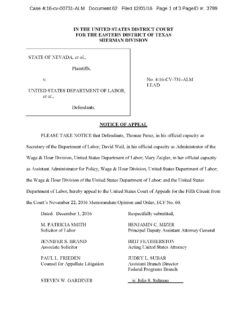
Notice of Appeal_Page_1On December 1, 2016, the day the Final Rule regarding the Fair Labor Standard’s Act (FLSA) was to go into effect, the U.S. Department of Labor (DOL) filed its Notice of Appeal of the Eastern District of Texas’ November 22, 2016 Memorandum Opinion and Order to the Fifth Circuit. What does this mean? Well, it seems largely symbolic to me – the DOL had plenty more time to file the Notice of Appeal, but did it on December 1. Coincidence? I think not. From here the Fifth Circuit will set a briefing schedule and decide whether to hear oral arguments. That being said, the briefing will not be due until after the Trump Administration takes office. So, whether the DOL chooses to withdraw the appeal, only time will tell. For now, employers should stay the course – continue to verify your employees are properly classified, and keep your ears open on this issue until a final decision has been made.

HighwayToday the State of Minnesota Department of Labor and Industry (MnDOLI) issued a Notice of Correction to Highway Heavy Prevailing Wage Rates. If you’re on their email list you should have gotten the notice. If not, you can sign up here. Here’s the notice in its entirety that I received from the email list (funny enough, but not surprising, it’s hard to find this notice on MnDOLI’s website):

Continue Reading MN Highway Heavy Contractors – Prevailing Wage Rates Corrected

Money2Well, by now everyone is aware of the injunction on the December 1, 2016 FLSA overtime Final Rule. Many employers had decided (a/k/a were forced) to increase an exempt employee’s salary to $47,476 to meet the DOL’s new (and now on hold) $47,476 threshold. So, now what? Can an employer just revert the employee’s salary, or not increase it as planned? Let’s put employee morale aside too…because certainly any reversion of a salary is not going to sit well with the employee who now may feel undervalued (and/or question whether he or she is properly classified anyway).

The Fair Labor Standards Act (FLSA) doesn’t address “promised” wages; accordingly, there is no federal requirement that an employee be paid a promised wage following an intervening event. Similarly, the Minnesota Fair Labor Standards Act (MnFLSA) does not impose any requirements on “promised wages”. But, Minnesota law does provide employees some protections in certain circumstances.

In Minnesota, “wages” is defined as: “Compensation due to an employee by reason of employment”.  Minn. Stat 177.23, Subd. 4.  Further, an employer cannot “directly or indirectly and with the intent to defraud…(2) directly or indirectly demand or receive from any employee any rebate or refund from the wages owed the employee under contract of employment with the employer…” or the employer can be liable for twice the amount in dispute.  Minn. Stat. 181.03. Why do I bring up this statute? Well, a salaried employee who is told she is getting a raise may try to argue she has a contract that she is “owed” those wages for the work she performs during the time frame she was told she’d get the raise. Is this a stretch? Probably, but then again, I’ve heard more far-fetching arguments than that. Also, notice the bold – “intent to defraud” – I think it’s safe to say, no employer was attempting a bait-and-switch here; it was all regulation driven and employers had the full intent (at the time) to increase a salary just to meet the new threshold.

In any event, for the cautious employer, you may want to provide the employee notice of the decrease prior to the period in which the employee would earn that money. So, for example, if the employee was told on November 25 that she would be getting a raise to $47,476 effective December 1, and the next payroll cycle is for the workweeks of November 21 to December 4 and paid on December 9, you may want to consider reverting back during the next payroll cycle that is for the workweek of December 5 to December 18 (so long as the employee is notified prior to December 5). That being said, this approach is being cautious – certainly in this instance there would be no “intent to defraud”, however, with this delayed decrease, there is no arguable “contract” with the salaried employee for the following payroll cycle (they may argue there is a contract for the payroll cycle encompassing December 1-5).

Yes, I’m fully aware that I did not address hourly employees here. Given they are hourly, and “earn” wages on an hourly basis, I would not expect the same argument to ever even remotely pop up. Finally, don’t forget to document the payroll change, preferably with the employee signing that he or she understands the change and applicable start date of the change.

MinnesotaJudicialCenterThe Minnesota Supreme Court has finally issued its Order stemming from this summer’s City of Minneapolis $15 minimum wage roller coaster.  On July 28, 2016, I wrote about Vote for 15MN’s petition to the City of Minneapolis to amend its Charter to require a $15 minimum wage by 2020 for large employers, and 2022 for small employers. If Vote for 15MN had its way, it would have forced the City of Minneapolis to put a ballot question for the general election which would ask voters to decide whether the City of Minneapolis Charter should be amended to require all Minneapolis workers to be paid at least $15 by the year 2020 for 500+ employers and 2022 for smaller employers (and thereafter adjusted based on the consumer price index).

However, later that day, the City of Minneapolis Attorney publicly filed a memorandum declaring that the proposed Charter was inappropriate for a ballot referendum. Vote for 15MN filed a lawsuit, Vasseur et al. v. City of Minneapolis et al., Court File No. 27-CV-16-11794, (Minn. Fourth Judicial District, Aug. 22, 2016), forcing the issue.  On August 22, 2016, Hennepin County District Court Judge Susan M. Robiner held in favor of Vote for 15MN, and resurrected the $15 minimum wage ballot question for the City of Minneapolis to put on the November 8, 2016 ballot, which I wrote about here. Not surprisingly, the City appealed Judge Robiner’s Order to the Minnesota Supreme Court for accelerated review. Funny enough – by that point, I refused to write about and speculate how I thought this would turn out! Not a bad idea on my part…as it turns out, the City of Minneapolis Attorney was correct in her analysis.

On August 31, 2016, the Minnesota Supreme Court revised the District Court’s order, concluding the proposed minimum wage amendment falls exclusively within the authority vested in the City Council over legislation and policy making. Given the accelerated nature of the review, the Minnesota Supreme Court deferred its detailed order on the issue, which was released yesterday. In sum, the Court opined:

Because Minneapolis residents do not have legislative and policymaking authority under the City Charter, we hold that the district court erred in granting the petition and ordering the City to place the wage amendment on the ballot for the general election.”

Accordingly, this issue is dead in the water for this method of changing minimum wage in any Minnesota city. That being said, certainly this is a movement that is not going to go away, so I expect the $15 minimum wage campaigns to continue, and perhaps statewide legislative efforts in lieu of City efforts.

Dont miss deadlineAlready this morning, my phone has not stopped ringing and the emails continue to pour in. The word is out – Judge Mazzant granted the emergency preliminary injunction, putting the December 1, 2016 FLSA DOL regulations on hold. What does this mean for employers and HR professionals that were scrambling to meet the December 1 deadline? All of your work preparing for the revisions can – and should – be put to good use. Remember, the white-collar duties test did not change! Thus, the ONLY employees who would have (theoretically) benefited from the rule changes, were those employees who met the duties test of a white collar employee, and who were paid more than $23,660, but less than $47,476, and thus needed to get a salary increase up to at least $47,476 to remain exempt.

In other words, embrace your internal audit and continue to use the old December 1 deadline as your internal target to reclassify employees. Again, the Final Rule has just been put on hold – it may rear its ugly head in the future and you’ll be back where you started. Thus, for those employees that were found to be misclassified after your internal audit, there is no reason not to reclassify them by December 1, as you were going to do. I love wage and hour litigation, but it is not employer friendly, and certainly not cheap. Thus, the only reprieve for employers is that you no longer need to increase the salary for properly classified white-collar exempt employees up to at least $47,476, until the final outcome of the Texas cases. If someone was determined to be misclassified based on their job duties (not salary), they are still misclassified – you can cut off damages and limit your potential liability by reclassifying them sooner than later (preferably by the December 1 deadline so there is some rationale as to why you are doing it now). As to the FLSA Texas cases and final outcome of the litigation – only time will tell. I’ll keep you posted.

Shermancourthouse1The Paul Brown United States Courthouse may be small, but as with everything in Texas, its reach is big and mighty.  On November 22, 2016, Judge Mazzant, of the Eastern District of Texas, Sherman Division, gave employers nationwide something to be thankful for this Thanksgiving. As I wrote about earlier, 21 states challenged the U.S. Department of Labor’s (DOL) revisions to the FLSA overtime regulations, as did over 50 businesses. The State Plaintiffs sought an emergency preliminary injunction, asking the Court to enjoin (put on hold) the Final Rule from taking effect, while the case is argued on its merits (which, you can imagine, takes much more time). The Court agreed in its Order today, that every state in the nation would be irreparably harmed if the Final Rule was allowed to proceed on December 1, 2016. Essentially, the December 1, 2016 deadline is no more, and the effective date has been put on hold pending the Court’s determination of whether it believes the Final Rule is valid.

Specifically, the State Plaintiffs questioned: (1) whether the Final Rule is lawful; (2) whether the DOL has the authority to promulgate it; and (3) whether the automatic salary updating mechanism complies with the Administrative Procedures Act.  In coming to its decision, the Court only had to address one, deciding that, “Congress defined the EAP [Executive, Administrative & Professional] exemption with regard to duties, which does not include a minimum salary level.” Further, the Court noted that the plain meaning of the statute explicitly delegates the DOL to, “establish the types of duties that might qualify an employee for the exemption, [and that] nothing in the EAP exemption indicates that Congress intended the Department to define and delimit with respect to a minimum salary level.” Accordingly, the Court concluded that the DOL’s Final Rule, “exceeds its delegated authority and ignores Congress’s intent by raising the minimum salary level such that it supplants the duties test” and is therefore unlawful.

If Congress intended the salary requirement to supplant the duties test, then Congress, and not the Department, should make that change.”

The Court did not analyze the legal issues relating to the automatic salary threshold or any of the State Plaintiff’s other arguments, given its decision with respect to the unlawful establishment of the minimum salary level.

Further, the Court held that if indeed the DOL lacks the authority to promulgate the Final Rule, then the public will be harmed by its enforcement (increased state budges, layoffs, and disruption to government functions). However, if it is ultimately decided that the DOL has such authority, then it will suffer no harm from the preliminary injunction and a delay from the enforcement. Accordingly, the Court noted:

A preliminary injunction preserves the status quo while the Court determines the Department’s authority to make the Final Rule as well as the Final Rule’s validity.”

Accordingly, the Court held that, “A nationwide injunction is proper in this case. The Final Rule is applicable to all states. Consequently, the scope of the alleged irreparable injury extends nationwide. A nationwide injunction protects both employees and employers from being subject to different EAP exemptions based on location.”  In conclusion, Judge Mazzano opined:

The State Plaintiffs have established a prima facie case that the Department’s salary level under the Final Rule and the automatic updating mechanism are without statutory authority. The Court concludes that the governing statute for the EAP exemption, 29 U.S.C. § 213(a)(1), is plain and unambiguous and no deference is owed to the Department regarding its interpretation.”

So, now what? Well, we can all enjoy our Thanksgiving a bit more, halting the scrambling that has been going on to come to a final decision on reclassification issues, increases in salary, and the like. That being said, employers who did an internal audit and determined that (regardless of the salary threshold) certain employees’s duties do not meet the duties test (which has not changed), would be wise to continue with the reclassification to ensure continued compliance (and because, frankly, we still don’t know what will happen with this case yet). Certainly, employees will understand that any changes made on December 1 were made with the new (now put on hold) regulations in mind and thus, a good of a reason as any to continue with any changed classifications.

As for the Texas lawsuit, the case now proceeds on the merits, while the business world (and States) can take a breath and not worry about enforcement – for now. However, the DOL may appeal the emergency preliminary injunction. That being said, losing a preliminary injunction is generally a preview of the final ruling to come, and thus, the DOL (especially with the new administration), may chose not appeal any such decision, rather allowing the case to proceed on the merits. I’ll keep you posted.

On November 14, 2016, the USCIS (U.S. Citizenship and Immigration Services) published a revised form I-9 (Employment Eligibility Verification) that must be used by all employers by January 22, 2017. The form, dated “11/14/2016” must be used after January 22, 2017. The previous form, dated 03/08/2013 must be replaced by that date.

What’s new? Instead of asking for “other names used” it asks for “other last names used”. It is easier to complete electronically with drop-down lists and on-screen instructions and an option to clear the form and start over.  It also adds prompts to ensure information is properly entered, employers may enter multiple preparers and translators, it has an area to add additional information, and has a supplemental page for the preparer/translator.

The revised form and more information can be found at USCIS’ website here.