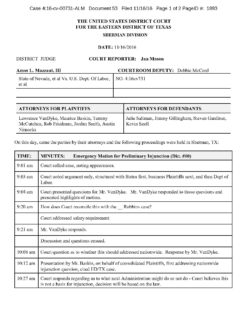
FLSA motion hearing_Page_1Today was the big day for the hearing on the emergency motion for preliminary injunction in the Eastern District of Texas challenging the FLSA regulations overhaul. As suspected, Judge Mazzant did not rule from the bench. The hearing began at 9:00 a.m. and the minutes reflect the following issues were discussed:

  • How is this case reconciled with the Robbins case?
  • Discussion of the salary requirement.
  • Discussion of whether this should be addressed as a nationwide injunction.
  • Discussion of new Administration – Judge Mazzant noted the change in the Administration is not a basis for an injunction, his decision will be based on the law and the factors for a preliminary injunction.
  • Discussion of the DOL’s limit to define the salary limit.
  • DOL argued methodological error and had to take different approach.

At 12:40 p.m. the hearing concluded. Judge Mazzant stated he will take the motion under advisement, but anticipates that his initial ruling will be issued on Tuesday, November 22, 2016. If he denies the emergency temporary injunction, a hearing will be set for Monday, November 28, 2016 on the summary judgment motion.

I’ve been fielding calls all week as businesses are getting wind of these cases and the upcoming December 1 deadline. As I wrote about earlier, employers would be wise to continue to prepare for the regulations overhaul until the law provides otherwise.
Texas FlagSince my last update on October 25, 2016 regarding the coalition of states and businesses suing the U.S. Department of Labor over the new overtime regulations, the parties have been busy and the Court has issued a few orders. Given the results of the recent elections (and the uncertainty of what will become of the new regulations with the new administration), for now, all eyes are on Judge Mazzant and the Eastern District of Texas. Here’s what has happening with the two cases:

October 31, 2016 – DOL’s Motion To Stay Summary Judgment Denied

On October 31, 2016, Judge Mazzant denied the DOL’s motion to stay summary judgment (the expedited motion filed by the Business Plaintiffs), but granted its motion to extend time to respond to November 18, 2016.  The Business Plaintiffs’ reply is due November 21, 2016. Judge Mazzant will hear the motion on November 28, “if necessary” (meaning, if he can’t decide on the documents, which I suspect he will given the anticipated very thorough briefing that will be done). In addition, the Court held that it will consider the Business Plaintiffs’ summary judgment brief as an amicus brief in support of the States’ motion for a preliminary injunction. In other words, the Court will consider the arguments of the Business Plaintiffs in the States Plaintiffs’ motion, and allow them to be heard at that hearing. The DOL has until November 7 to respond to that amicus brief.

November 7, 2016 – DOL Files Response to Business Plaintiffs’ Amicus Brief

On November 7, 2016, the Defendant DOL filed “Defendants’ Memorandum of Law In Response to Position of the Business Plaintiffs Treated as Amici With Regard to the State Plaintiffs’ Motion for Preliminary Injunction pursuant to Order of October 31, 2016”. In English – on October 31, Judge Mazzant said he would consider the relevant portions of the Business Plaintiffs’ summary judgment brief in the States’ case.  This is often done at the U.S. Supreme Court level, and other instances where there is a lot at stake and the judge desires to have the benefit of all the positions and learned minds.  This brief is the DOL’s response to the Business Plaintiffs’ position.

November 10, 2016 – Plaintiff States Filed Their Reply Brief

Finally, the last document filed in this case to date, on November 10, 2016, the States replied to the DOL’s response to their emergency motion for preliminary injunction. In short, the States argue the DOL’s entire argument surrounds “ambiguity” made without “specific Congressional authorization.” Further, the States argue that the DOL has basically preempted the duties test and making it a “salary only” test, ignoring 75 years of the prevailing duties test. Should they lose, the States argue they will suffer irreparable harm – to the tune of $115.1 million the first year in increased state and local costs, as conceded by the DOL in its response brief. Accordingly, the Plaintiff States request the preliminary injunction be granted.

Stay tuned – the saga will continue!

clickAs a result of President Obama’s White House Summit on Worker Voice, on October 28, 2016, the U.S. Department of Labor’s Wage and Hour Blog announced its new beta website – Worker.gov. This website is, according to the DOL, designed to provide “easy-to-access” solutions for employees who need answers “fast”. The DOL admits that “Even the best government websites can be difficult to navigate” – true, true. That being said, it makes it only about 4 clicks for a worker to file a claim electronically.
In short, the website, which is in beta and therefore undergoing constant changes, is designed to provide employees with an easy way to determine whether their rights are being violated, then provides them with a simple click to file a claim against an employer. Partnering with the NLRB, EEOC, and DOJ, the DOL wants the website to provide “critical information” to employees about their rights, who may not know whether they have a “FLSA” or “FMLA” problem, but an “unfairness-on-the job problem”. Employees answer a “few simple questions” and voila! The website will supposedly provide the relevant information, expanding in the weeks and months to come, and “learning” from the workers that use it about what kind of information is being sought – and the site will supposedly begin to feature that information prominently for similar workers.

The beta site provides a drop down, under which five job titles are currently available – day laborer; office worker; nail salon worker; restaurant worker; and construction worker. From there, it takes to you a “Tell Us what happened. We can help.” screen with several options such as – “You have the right to be treated equally.”, “You have the right to engage with others to improve wages and working conditions”, “You have the right to a safe and healthy work environment”, and “You have the right to be paid.”  From there, the employee can chose what happened (i.e. suggestions – all are in the negative – such as “I was not paid for work I performed”) , and then be taken to a “File a Claim” screen.

What does this mean for employers? I have to believe we will see an increase in filed complaints, as that is the whole purpose of the website – to make it easy for employees to complain about unfair work treatment – and provide a simple click to do so.

USDOL_Seal_circa_blue_2015The U.S. Department of Labor (DOL) has recently issued a new Fact Sheet – Treatment of Bonuses for Exempt White Collar Employees. As with any fact sheet, the sole purpose is to attempt to make its unclear regulations clear, without changing or interpreting the regulations. That being said, they are often helpful (though also often fail to overlook exceptions which may be favorable to the employer and focuses on the general rule for the employee), and certainly can provide a look into how the DOL interprets its own regulations.
In this case, the Fact Sheet provides a regurgitation of the December 1 regulations as to how non-discretionary bonuses may now (in December) be included (up to 10%) toward the salary level test. It provides examples of how this will work with highly-compensated employees (HCE), confirming that the HCE must still meet the salary basis test with only a 10% credit towards the $47,476 threshold. In other words, a HCE that makes less than the new $47,476 salary threshold, let’s say, $15,000, but earns a $145,000 bonus, would not meet the exemption, even though the total compensation is more than the $134,004 threshold for HCEs. The DOL is quick to explain this does not mean bonuses must be capped, they can make more than 10% bonuses, but the salary threshold of $47,476 must be only credited 10% of bonuses – even if the person is ultimately a HCE. In addition, the DOL provides examples for the quarterly catch-up payments, noting such payments are credit toward prior quarter’s salary requirement and not the current quarter in which it was paid. It’s an easy read, so I won’t go on, but it’s out there, and I expect more to come, especially as we are T-minus 30.

Sleep breakSeems simple enough, right? Not so fast! In Minnesota, “hours worked” is generally defined as “training time, call time, cleaning time, waiting time, or any other time when the employee must either be on the premises of the employer or involved in the performance of duties in connection with his or her employment or must remain on the premises until work is prepared or available.”  Minn. Rule 5200.0120. As always, this definition is not entirely helpful. For example, does “training time” include seminars that the employee wants to go to outside of normal work hours, or a free seminar during work hours? What about non-mandatory training opportunities? As is frequently the case – it depends, and often depends on the facts. However, a few general rules of thumb follows:

Rest & Meal Breaks 

Employees who work 4  consecutive hours must be provided time to use the nearest restroom. Rest breaks of less than 20 minutes are counted as “hours worked”. Employees who work at least 8 consecutive hours must be provided a meal break (sufficient time to eat a meal). Meal breaks are not counted as hours worked – but should “generally” be 30 minutes or more (so says the State), so the employee is “completely relieved from duty” to eat. Minor interruptions in meal time is okay, but frequent interruptions would convert this to paid work time. Thus, it is a good idea to require employees to step away from their workstation during meal times. Fun fact – there is no mandatory “smoke break” – employees have no right to a smoke break, but certainly they may chose to use their meal break or other provided rest break for such a purpose.

On-Call Time

Under Minnesota law, employees who must remain on premises or so close that they cannot use time “effectively” for personal purposes, must be paid for on-call time. Employees on-call away from work are not working, unless called to work. There is, of course, much more to this (for example, paramedics who may work 24 hour shifts are not always “working” during the 24 hours shift), but for purposes of this quick overview, that’s the general rule – whether the employee is “engaged to wait” (paid) or “waiting to be engaged” (unpaid).

Sleep Time

If an employee is scheduled for less than 24 hours per day, sleep time (with some exceptions – see below) is work time, even if you allow them to sleep. Minn. Rule 5200.0121. Employees scheduled 24 hours or more do not need to be paid for meals and a sleeping period (less than 8 hours), so long as there are adequate sleeping facilities and the employee can usually get at least 5 hours of uninterrupted sleep. However, it is critical that there is an understanding/agreement (doesn’t have to be in writing – but very good practice). Work performed during the sleep time must be compensated and if the sleep time is interrupted so the employee cannot get at least 5 hours of sleep, the entire period is work time.

On-Site Employees

Here is one of the exceptions to the above sleep time rule. Caretakers, managers and other on-site employees of residential buildings, whose principal place of residence is the residential building, and who receive the residence as full or partial compensation for duties performed, must be paid for time spent on duties, but no other time. Minn. Stat. 177.23, Subd. 10.

Companionship Service

Another exception to the above sleep time – employees who provide companionship services (29 CFR 552.6 and 552.106) to individuals unable to care for their own needs, who are employed to stay overnight in the home with the individual(s), and who are paid at least minimum wage for 4 hours for the overnight stay. For those, the term “hours” worked does not include nighttime hours of 10 pm to 9 am – for a total of 8 hours per night, during which the employee is able to perform duties, but is not in fact performing such duties and can sleep or do other things in the home.  Minn. Stat. 177.23, Sub. 11.

As always, the law is not super clear, and there is certainly case law and other guidance to support any one situation. The exceptions to the rule almost always overshadow the rule in wage and hour law. For example, there is a plethora of guidance about paramedics, EMT’s and other first responders, and of course, on-call time is particularly contentious. When in doubt, as I always say, dig deeper!

WorkweekHere is a hint – it is NOT Monday – Friday. Believe it or not, as frequently as this term is used, it is not often use properly. A workweek (or work week or work-week) is actually defined by the Minnesota Fair Labor Standards Act (MnFLSA) and Fair Labor Standards Act (FLSA). Accordingly, employers should not take this term lightly. What’s the fuss? Well, a “workweek” is defined by both the MnFLSA and FLSA to be a period of 168 hours during 7 consecutive 24 hour periods. How you designate it (if at all) can affect your payment of overtime and minimum wage.

Fun fact – the workweek can actually begin on any day of the week and at any hour of the day, as decided by the employer. This is key because the workweek is used to determine minimum wage and overtime. Thus, employers should designate the applicable workweek in your employee handbook. If you don’t designate it, it is presumed to be a calendar week (Sunday 12:01 a.m. to Saturday 11:59 p.m.). This can have significant impacts on overtime in businesses that have more FTE work hours on certain days than, say for example, a workforce of M-F, 9-5. For example, if your busy days are Friday – Sunday and employees work many hours those days and less others, you may want to consider a workweek of Saturday – Sunday, to split the heavy consecutive days up.

Also, keep in mind that, while employers may prospectively change the workweek from time-to-time, it must be “fixed” and thus, cannot be temporary, or changed to avoid overtime. The idea is that you set it and leave it (or reset it and leave it).  Generally, a business has its customary busy days (for example, retail on the weekends), which doesn’t change much, so changing your workweek too frequently may raise some eyebrows.

volunteerI was having lunch the other day with a colleague who practices non-profit law in Minnesota.  As is often the case, we chat about issues facing our clients. Naturally, we started talking about whether not-for-profit entities are subject to the Fair Labor Standards Act (FLSA). The answer is that it depends on whether the entity is “covered”, or the individual is “covered”. In other words, there is no exemption for non-profit employers and whether the entity is covered is the same as any for-profit entity. Indeed, the Department of Labor’s (DOL) updated regulations apply to for-profit and not-for-profit entities alike. In fact, on May 18, 2016, the DOL published its Guidance for Non-Profit Organizations on Paying Overtime under the Fair Labor Standards Act. In addition, it published another handout, Overtime Final Rule and the Non-Profit Sector.

Can A Charitable Organization Not Be A Covered Enterprise?

Sure. In order for your organization to be covered, it must have annual revenues (sales made or business done) over $500,000. Unless your organization is engaging in “ordinary commercial activities” (such as a gift shop), with sales in excess of $500,000, it is not covered (keep reading though, because this does not mean the FLSA does not apply to your employees). When determining enterprise coverage, the DOL will look to see if the non-profit is engaging in activities “for a business purpose” as opposed to, for example, activities that are charitable such as providing clothing, food, temporary shelter, hotline counseling services, and the like. That being said, income used to further the charitable activities such as contributions, donations, membership fees and dues (with some limitations) is not included in the $500,000 threshold.

Can An Employee of A Charitable Organization Be Covered Individually?

Yes. This will happen when an employee’s work activities are regularly engaging in interstate commerce – which is almost always given our connected society (email across state lines, phone calls out-of-state, credit card transactions, etc.). That being said, the DOL has stated in its guidance that it is not going to use its resources to find that needle in a haystack, but will look more to whether an enterprise is covered. It seems the DOL does have a weakness for charitable organizations…but I wouldn’t bank on it.

How Does the FLSA Overtime Regulations Apply to Your Non-Profit?

If you get to join the FLSA club, the DOL’s regulations apply just as they would if you were a for-profit entity. Accordingly, you can find out more information in my earlier posts, the one summarizing the overtime overhaul can be found here. In short, you will need to pay minimum wage plus overtime unless your employees meet one of the white-collar or other stated exemptions.

What About Volunteers?

Individuals generally cannot “volunteer” for a commercial activity (such as working in the gift shop). These rules have not changed with the revised overtime regulations. A volunteer is one who volunteers freely for a non-profit for public service, etc. without expecting compensation. If the individual is a full-time “volunteer”, you should look carefully to be sure that the individual is not crossing the line displacing work of an employee (typically volunteers are part-time). Similarly, a paid employee should not be allowed to “volunteer” for the same non-profit in the same capacity as the work the employee is paid for. In short, if the volunteer is an integral part of the organization, you may want to take a second look at the classification of the employee and/or conduct an internal audit of your wage and hour practices. Finally, don’t forget about Minnesota wage and hour laws…just because the FLSA may not apply, does not mean that Minnesota law does not provide employees certain protections (yes, that’s another blog for another day!).

texasThey say, everything is bigger in Texas – who knew that would apply to lawsuits as well? As I wrote about earlier, on September 20, 2016, the State of Nevada, along with 20 other states sued the U.S. Department of Labor in the Southern District of Texas challenging the revised FLSA overtime regulations (the “State Plaintiffs”). The same day, the U.S. Chamber of Commerce and 55 businesses and industry groups followed suit (the “Business Plaintiffs”) under a slightly different theory. If successful, a single judge in Texas could decide to put a hold on the upcoming December 1, 2016 overtime revisions – including the increase in the white-collar salary threshold to $47,476 – affecting over 4 Million workers. For wage and hour attorneys like myself, this is like watching the Super Bowl, with each motion being a commercial.

On October 12, 2016, the State Plaintiffs filed an Emergency Motion for Preliminary Injunction and Request for Oral Argument and Expedited Consideration, which the DOL must respond to by October 31.  The parties each get to file a reply to the other’s argument, and the hearing will be November 16. Similarly, on October 14, 2016, the Business Plaintiffs filed a Motion for Summary Judgment, which the DOL also must respond to by October 31.  Coincidence?  I think not – great timing/coordination on the plaintiffs’ part. On October 17, the Business Plaintiffs moved to consolidate the two cases. On October 18, 2016, the DOL filed an Emergency Motion to Stay the Business Plaintiffs’ Motion for Summary Judgment and Motion for Extension of Time to File Response/Reply (basically asking the Court for more time to respond). The same day, the Court consolidated the two cases (meaning, they will proceed as one), under the State Plaintiffs’ case (since it was filed first).

On October 21, the Business Plaintiffs responded to the DOL’s Emotion Motion to Stay Summary Judgment Briefing, noting that a decision needs to be made prior to December 1 ,2016, and that the arguments before the DOL are not foreign to it, and that they “routinely confront these arguments in litigation challenging regulations.”  On Monday, October 24, 2016, the DOL filed its reply, arguing that the case should not be rushed as it “raises complex legal questions that could, on resolution, affect the rights of over four million American workers and their employers.” However, the DOL also hinted that it will argue that the injunction, if granted, should not be on a nationwide basis, but only those states that have filed suit (which would not include Minnesota).

On November 16, 2016, the hearing on the State Plaintiff’s Emergency Motion for Preliminary Injunction will be heard before Judge Mazzant. The status whether the Business Plaintiffs’ motion for summary judgment will proceed is up in the air. Until then, I’ll keep watching the commercials and keep you posted!

child laborWell, summer went by way to fast, and the kids are back in school. I’ve had a few parents of teens mention they cannot believe their kid is being scheduled to work until 10:30 p.m. at night – closing up nonetheless! Is that okay? Depends. Minnesota employers should recall that youth work rules change during the school year to be more restrictive. For those parents wanting or “allowing” their kid to work later – no can do. Like wage and hour laws, you can’t “agree” around the law. It is what it is. So, what is it? For non-agricultural occupations (where the parent is not the employer):

Large Employers (FLSA employer – annual sales more than $500,000):

  • Youth 14 and 15 cannot work:
    • Before 7 a.m. or after 7 p.m. (except from June 1 to Labor Day may work until 9 pm);
    • More than 18 hours during a school week;
    • During school hours on a school day (even if home schooled);
    • More than 3 hours a day on a school day (includes Fridays);
    • More than 8 hours a day on a non-school day; or
    • More than 40 hours during a non-school week.
  • Youth 16 and 17 cannot work (by Minnesota state law, which is more restrictive):
    • After 11 p.m. on nights before a school day (except can work until 11:30 with parent permission); or
    • Before 5 a.m. on a school day (except can work at 4:30 a.m. with parent permission).

Small Employers (not subject to FLSA – annual sales less than $500,000):

  • Youth 14 and 15 cannot work:
    • Before 7 a.m. or after 9 p.m.;
    • More than 40 hours a week; or
    • During school hours on a school day.
  • Youth 16 and 17 cannot work:
    • After 11 p.m. on nights before a school day (except can work until 11:30 with parent permission); or
    • Before 5 a.m. on a school day (except can work at 4:30 a.m. with parent permission).

Keep in mind, the work youth performs is still greatly restricted, as I wrote about earlier this summer (such as construction, sawmills, operating power-driven machinery such as forklifts and saws; etc.).

3D_Judges_GavelThe Minnesota Chamber of Commerce, along with several other employer groups such as TwinWest Chamber of Commerce, filed a lawsuit today in Hennepin County challenging the City of Minneapolis’ new Sick & Safe Leave Ordinance – as recently amended. The press release summarizing the action can be found here. In short, they argue that the ordinance conflicts with Minnesota state law, namely, that it is “unworkable” and “unlawful”, and that employers need statewide workplace regulations that are consistent. If you want to read the memorandum in support of the temporary injunction, you can find it on KSTP’s website here. What’s next? The parties will get a hearing date, the judge will likely take it under advisement, and issue an order either temporarily enjoining the City of Minneapolis from enforcing the ordinance, or disallowing such injunction. I would not be surprised to see a similar action filed in St. Paul, challenging its newly enacted sick and safe leave ordinance, modeled after the City of Minneapolis’ ordinance. Stay tuned!